


Most shoppers find online stores through low-volume searches. Here's why ranking for popular keywords isn't enough and how filter and product pages capture the long tail.

Imagine you run a home appliance store and want to attract more customers from Google. Where do you start? The obvious goal is to reach the top three results for searches like “refrigerator” and “buy refrigerator.” But while your store competes for those positions, a large share of search demand goes unnoticed.
It's easy to see why. Thousands of people search for popular products every month, and higher rankings generally bring more visitors to a website. That's why online stores often compete most fiercely for short, broad search terms.
The problem is that shoppers don't stop at “refrigerator” or “buy refrigerator.” They specify dimensions, brands, and features, or search for an exact model. Each of those searches is another opportunity to win an order.
Research suggests that almost 93% of search queries receive fewer than 10 searches per month.
One shopper searches for “Samsung No Frost refrigerator”; another looks for a “narrow refrigerator under 55 cm.” Someone else wants a “refrigerator with a bottom freezer,” while another enters an exact model number.
Each query may bring only a handful of visits on its own. But there are thousands of them. Together, these low-volume searches form what SEO specialists call the “long tail.”
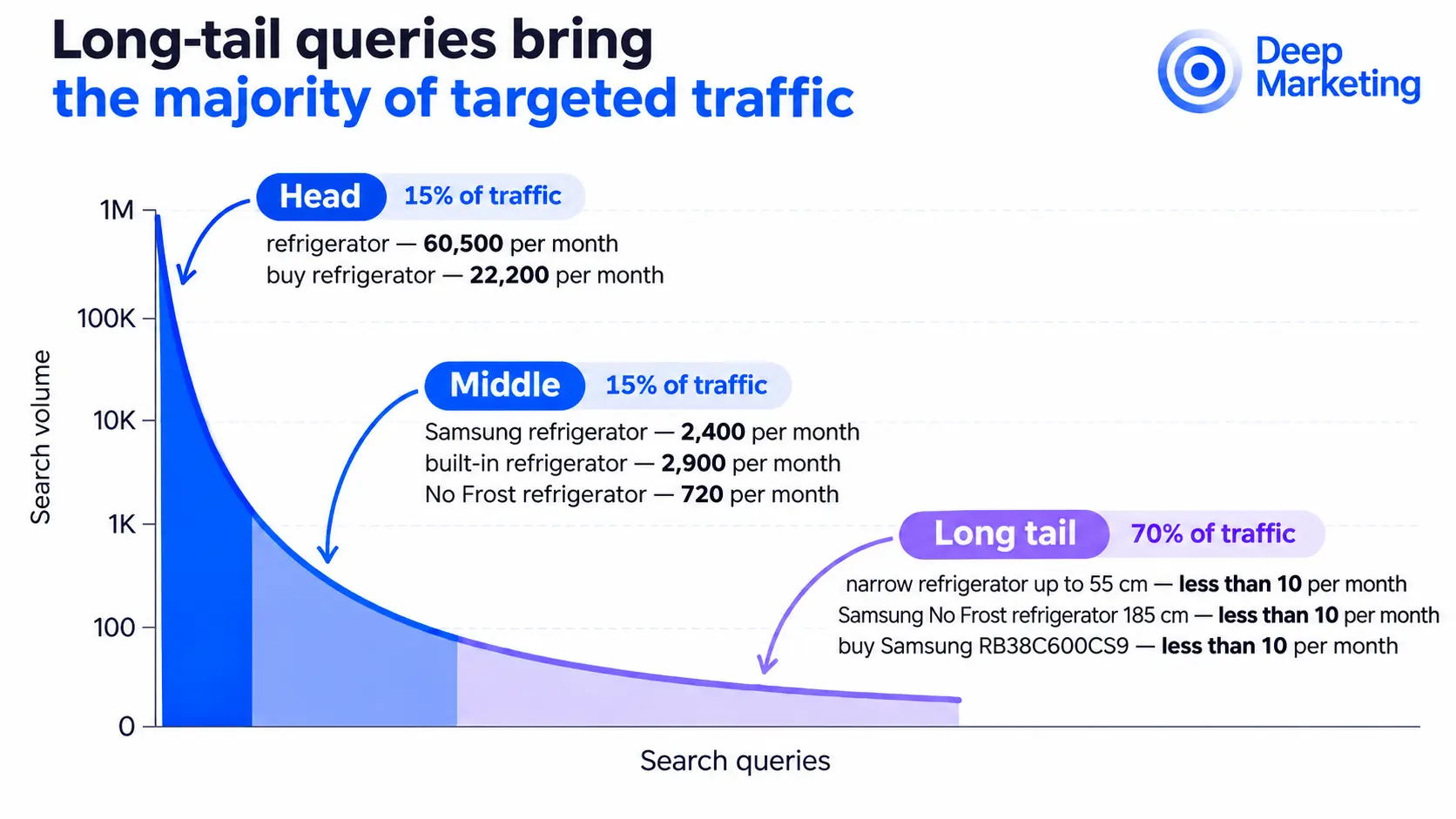
There's another reason to pay attention to these searches: they often tell you how close someone is to making a purchase.
A search for “refrigerator” could mean almost anything. The person might be browsing products, checking prices, or simply learning what to look for. “Samsung No Frost refrigerator 185 cm” is much more specific. And someone searching for “buy Samsung RB38C600CS9” has likely chosen a model and is deciding where to buy it.
As a result, visitors arriving through highly specific searches often convert at a higher rate. A thousand visits from these searches can generate significantly more orders than a thousand visits for the broad keyword “refrigerator.”
You don't necessarily need hundreds of new articles or a complete catalog overhaul. Start with the pages your online store already has: filter pages and product pages.
Filter pages. If people search for “Samsung No Frost refrigerators,” they need a page showing exactly that selection. It should have its own URL, a clear title, and be accessible to Google. The same applies to other combinations of product features that people search for.
Product pages. When shoppers search for a specific model, they should be able to find that product in your store. That means including the exact model name in the product title and the main specifications people use when searching for it.
Thorough keyword research reveals thousands of opportunities to attract shoppers that many stores overlook. Systematically optimizing a large number of filter and product pages allows you to capture that demand and bring more qualified traffic from Google. This approach can increase orders and sales from organic search several times over.
Briefly tell us about your business, current situation, or task — we'll get back to you with a proposal, without unnecessary calls or formal presentations.