


Do you need llms.txt? Does Schema markup help? Does GEO replace SEO? We test 5 popular AI search myths against 2025–2026 research.

ChatGPT and Google's AI Overviews are changing how people find information online. Their growing popularity has also given rise to a new field of digital marketing: Generative Engine Optimization (GEO).
There's no shortage of advice on how to get your website featured in AI-generated answers. Some recommendations are backed by research. Others sound convincing but have little evidence to support them.
We reviewed studies published in 2025 and 2026, along with Google's official guidance, to examine five of the most common myths about AI search optimization.
The idea behind llms.txt is straightforward. You place a Markdown file in your website's root directory describing its most important pages, supposedly making it easier for large language models to understand and reference your content.
But does it actually work?
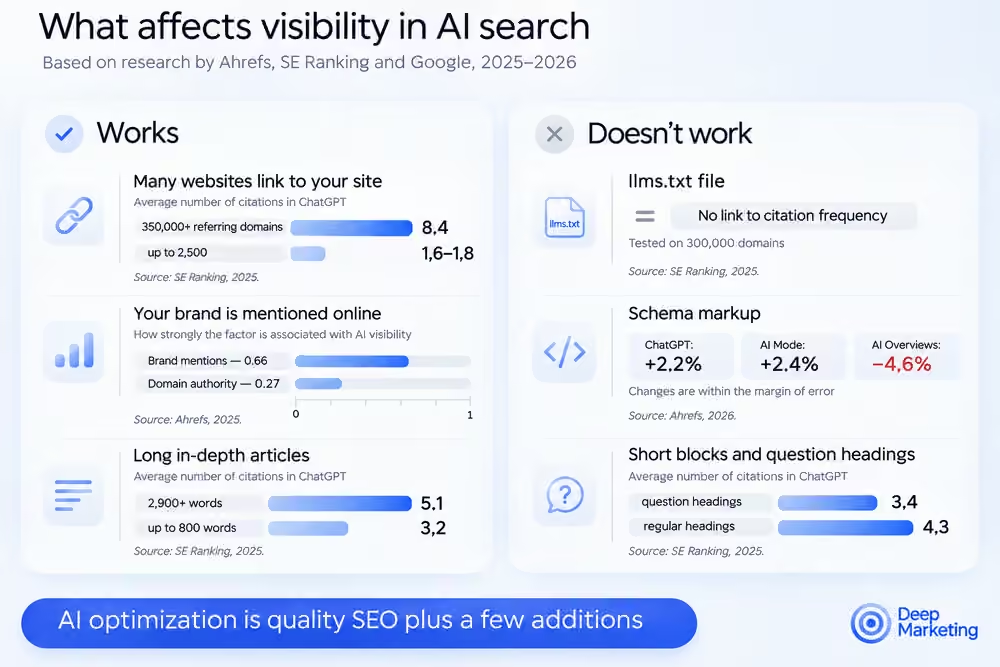
SE Ranking analyzed approximately 300,000 domains and found that around 10% had implemented an llms.txt file. The researchers found no meaningful relationship between having the file and how frequently a website was cited by AI systems.
In fact, removing llms.txt as a variable from their predictive model slightly improved its accuracy.
Google reached a similar conclusion in its official guidance published in May 2026. The company explicitly stated that websites don't need additional machine-readable files created specifically for AI search features.
The takeaway: Adding an llms.txt file is unlikely to hurt your website, but there's no convincing evidence that it improves AI visibility. It's certainly not something worth prioritizing over established SEO practices.
Structured data is often described as a language that helps AI understand web content. This has led to the assumption that implementing Schema.org markup will make websites more likely to appear in ChatGPT responses and Google's AI-generated answers.
Ahrefs tested this theory in a controlled experiment. Researchers added JSON-LD structured data to 1,885 pages and compared their performance against 4,000 similar pages that remained unchanged.
The results were underwhelming. Citation rates in ChatGPT and Google AI Mode showed no statistically meaningful improvement. In Google AI Overviews, citations actually declined slightly, by 4.6%.
It's true that pages with structured data tend to receive more AI citations overall. However, that doesn't necessarily mean the markup is responsible. Websites that implement structured data are often better optimized in other areas as well, including content quality and technical SEO.
Google has also confirmed that no special structured data markup is required for its AI search features.
The takeaway: Schema.org remains a valuable SEO tool, particularly for qualifying for rich results in Google Search. But adding structured data alone hasn't been shown to increase the likelihood of being cited by AI.
One of the most common GEO recommendations is to structure content into short question-and-answer blocks, keep each answer between 40 and 60 words, and turn headings into questions. The reasoning is that shorter, self-contained sections are easier for AI systems to extract and cite.
Research, however, paints a different picture.
SE Ranking analyzed more than 216,000 pages and found that longer articles were cited more frequently than shorter ones. Content exceeding 2,900 words received an average of 5.1 ChatGPT citations, compared with just 3.2 for articles under 800 words.
The same pattern appeared at the paragraph level. Sections containing 120–180 words performed better than those with fewer than 50 words. Traditional descriptive headings also outperformed question-based headings.
Google's official guidance reinforces these findings. There's no need to artificially break content into smaller pieces or rewrite articles specifically for AI systems.
What does appear to help is providing useful information supported by specific facts, statistics linked to credible sources, and insights from recognized experts.
The takeaway: Write for your readers, not for algorithms. Thorough, well-researched content that answers real questions is more valuable than articles artificially formatted to satisfy supposed AI preferences.
The rapid adoption of ChatGPT and other AI assistants has created the impression that traditional search is becoming irrelevant. But the traffic numbers tell a different story.
According to an August 2026 research roundup published by Clickport, AI assistants account for less than 2% of total traffic for most websites.
That doesn't mean AI isn't affecting search behavior. The changes are simply happening in a different way.
A Pew Research Center study found that when Google displays an AI Overview, only 8% of users click a traditional search result. Without an AI Overview, that figure rises to 15%.
In other words, Google remains an essential source of traffic, but the way users interact with its search results is changing. Websites now need to consider not only their organic rankings but also their visibility within AI-generated answers displayed directly on Google's results pages.
There's another widespread assumption worth questioning: that visitors arriving from ChatGPT are significantly more likely to buy. A study covering 973 online stores found that ChatGPT referrals converted into purchases less frequently than traffic from most other channels.
The takeaway: AI search is an emerging acquisition channel, but it hasn't replaced traditional organic search. For eCommerce businesses, the priority should still be attracting qualified visitors through Google while adapting to the growing presence of AI-generated search features.
One of the most expensive mistakes businesses can make is building an entirely new AI optimization strategy while neglecting traditional SEO. In reality, visibility in Google Search and citations in AI-generated answers are closely connected.
According to AirOps, 55.8% of the pages cited by ChatGPT also appear in Google's top 20 search results. Pages ranking in the number-one position are cited 3.5 times more frequently than pages outside the top 20.
SE Ranking's research points in the same direction. Among the factors most strongly associated with ChatGPT citations are the number of referring domains and website loading speed — both familiar elements of traditional SEO.
Google's own guidance is equally clear: established SEO best practices remain the foundation for visibility in its AI search features.
The takeaway: GEO isn't a replacement for SEO. Much of what makes a website successful in traditional search also contributes to its visibility in AI-generated answers.
Getting your website mentioned more frequently in AI-generated answers doesn't require rebuilding your entire SEO strategy. A technically sound website, valuable content backed by reliable information, and a strong backlink profile remain essential for visibility in both traditional and AI-powered search.
However, recent research highlights several areas that deserve particular attention.
Meanwhile, popular tactics such as creating an llms.txt file, adding special AI-focused markup, or writing content specifically for language models still lack convincing evidence of effectiveness.
The conclusion is straightforward: a solid SEO strategy already provides much of the foundation for AI search visibility. Rather than chasing every new GEO tactic, businesses would be better served by improving their websites, publishing genuinely useful content, earning quality backlinks, and building brand recognition.
These are the practices that have delivered results in traditional search for years, and the available evidence suggests they matter in AI search as well.
Briefly tell us about your business, current situation, or task — we'll get back to you with a proposal, without unnecessary calls or formal presentations.