


Why blog traffic rarely converts, how AI Overviews cut informational clicks, and when an ecommerce blog is actually worth the investment.

Every online store seems to be told the same thing: you need a blog. Competitors have one, so retailers hire writers and start publishing articles regularly. Six months later, the blog is attracting visitors, but hardly any of them are buying anything.
Is a blog really worth the investment? Let's look at when blogging makes sense for an ecommerce business and when those resources would be better spent elsewhere.
Most blog posts target informational searches: “how to choose,” “which is better,” or “what’s the difference between.” People making these searches are usually still researching their options rather than looking to buy.
The numbers illustrate just how much that matters. A case study covered by Search Engine Journal found that content targeting high-intent search queries achieved a 4.78% conversion rate, compared with just 0.19% for informational content. That's roughly a 25-fold difference.
Although the study focused on SaaS, the same principle applies to ecommerce. An article titled “How to Choose a Vacuum Cleaner” might attract 10,000 visitors and generate fewer orders than a well-optimized “Robot Vacuum Cleaners” category page receiving just 1,000 visits.
This is why judging a blog's success by traffic alone can be misleading. What matters to an online retailer is how many of those visitors eventually become customers.

Google's AI Overviews are making things even more challenging by providing answers directly in search results.
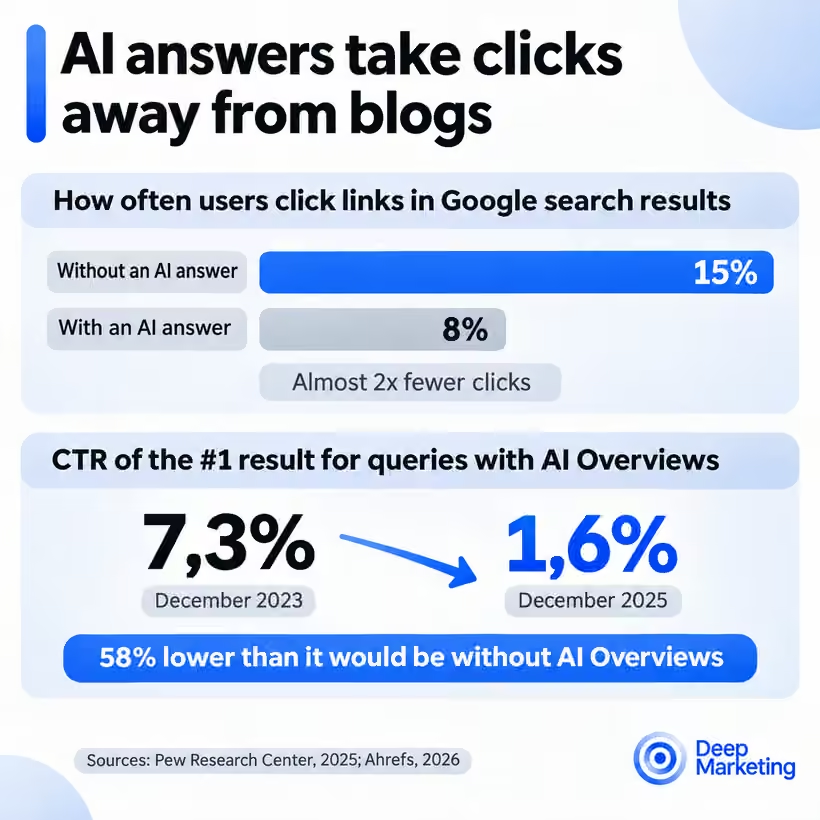
According to updated Ahrefs research from 2026, the click-through rate for the top organic result dropped by 58% on searches that triggered an AI Overview. Pew Research found a similar pattern: users clicked traditional search results in just 8% of searches featuring an AI summary, compared with 15% when no summary appeared.
Informational queries are particularly vulnerable to this shift. In the past, someone looking for an answer might have visited several websites. Today, they can often find what they need without leaving Google.
For publishers and ecommerce blogs, that means more competition for fewer clicks. Even a well-written article ranking near the top of search results may receive substantially less traffic than it would have a few years ago.
Investing heavily in a channel where organic traffic is shrinking only makes sense if you have a clear understanding of the business value it delivers.
One common ecommerce SEO mistake is creating blog posts for searches that would be better served by category, filtered listing, or product pages.
Take a query like “best running shoes under $100.” In many cases, shoppers would get more value from a curated product listing where they can compare prices, features, and available options than from a general buying guide.
When a store publishes a separate article targeting the same query, it can end up competing with its own commercial page in Google. This is known as keyword cannibalization. Sometimes the blog post ranks instead of the category or filtered listing, even though the latter offers a much clearer path to purchase.
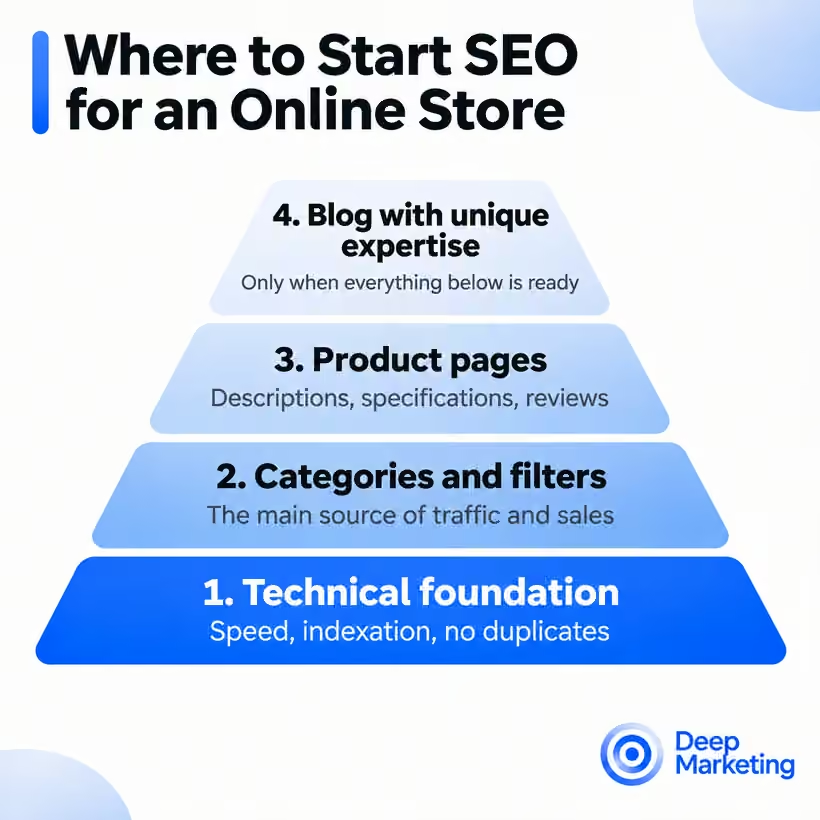
Commercial pages should remain the foundation of an online store's SEO strategy.
Research by JumpFly and seoClarity, based on large US ecommerce websites, found that category pages generated approximately 413% more organic traffic than individual product pages.
Filtered category pages are equally important. They allow retailers to target thousands of specific searches from shoppers who already know what they want, whether that's a particular brand, size, color, feature, or price range.
These visitors are typically much closer to making a purchase than someone reading a general advice article.
Before commissioning another blog post, it's worth checking whether your most important categories and filters are properly optimized. Improving those pages may generate significantly more revenue than publishing additional informational content.
A blog becomes a worthwhile investment once the store's core commercial pages are in good shape. Categories and filters should be optimized, product listings should contain the information shoppers need, and major technical SEO issues should be resolved.
Even then, simply publishing articles on a regular schedule isn't enough. Two principles can make the difference between a blog that adds real value and one that just consumes resources.
1. Publish information your competitors don't have.
Another article offering “10 Tips for Choosing a Laptop” is unlikely to attract much attention if it simply repeats advice already available on dozens of other websites.
Google's guidance on creating helpful content emphasizes the importance of original information, research, and analysis. Its patent documentation also describes the concept of information gain: the extent to which a piece of content adds something new to what is already known.
Online retailers are particularly well positioned to create this kind of content. They can publish results from hands-on product testing, analyze their own sales data, explain common reasons for product returns, or compare models based on first-hand experience.
That kind of information is difficult to find elsewhere. It helps customers make informed purchasing decisions while demonstrating that the retailer genuinely understands the products it sells.
Original, expert-led content can also strengthen a store's reputation and build trust in the brand. However, having an authoritative blog does not automatically translate into higher rankings for commercial pages.
2. Make blogging part of your broader content marketing strategy.
An article that gets published and then sits on your website waiting for Google traffic has limited potential. A strong piece of content can do much more.
Research findings can become a series of social media posts. Interesting statistics can be turned into infographics. Practical recommendations can be adapted into short videos, while the main takeaways can be shared through email newsletters.
This approach allows a blog to do more than attract organic search visitors. It can introduce new customers to your brand, keep existing customers engaged, and establish your business as a trusted source of expertise within its niche.
That's a much more valuable role than simply generating additional clicks from search results.
A blog isn't essential to running a successful online store. The first priority should be category pages, filtered listings, and product pages because they attract people who are already looking to buy. Once those foundations are in place, investing in original, expert content and distributing it across other marketing channels makes sense. Get the priorities wrong, and you risk spending heavily on a blog while your store misses out on sales because its most commercially valuable pages remain poorly optimized.
Briefly tell us about your business, current situation, or task — we'll get back to you with a proposal, without unnecessary calls or formal presentations.